
Wireless Infrastructure for Healthcare Facilities
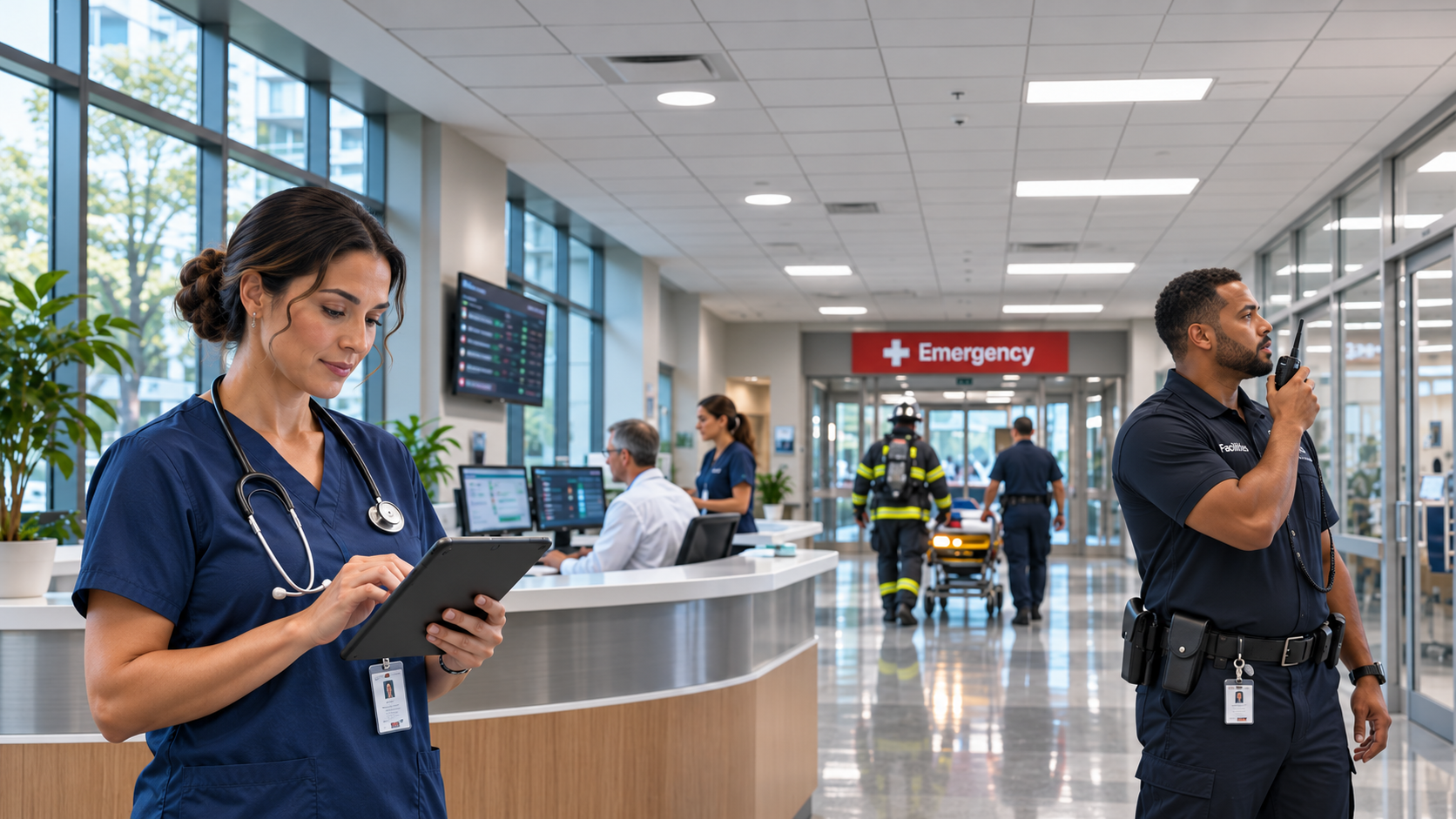
ERCES, Cellular DAS, and private two-way radio systems serve different needs in healthcare facilities. Image: MobileNet Services
Healthcare facilities depend on reliable communication among clinicians, patients, visitors, facilities personnel, security teams, and emergency responders. Yet features such as reinforced construction, specialized medical spaces, multiple floors, and ongoing renovations can make dependable indoor wireless coverage difficult to achieve.
Emergency Responder Communication Enhancement Systems (ERCES), Commercial Cellular Distributed Antenna Systems (DAS), and private two-way radio systems solve different communication challenges. Each serves a different network and user group, but all benefit from early RF evaluation and coordinated construction planning.
For hospital owners, general contractors, developers, and facility managers, understanding these differences early can help limit rework, coordinate work around patient care, and prepare for future expansion.
Table of Contents
1. Why Healthcare Facilities Are Unique Wireless Environments
2. Three Wireless Networks, Three Different Purposes
3. ERCES: Emergency Responder Communications in Hospitals
4. Cellular DAS: Connecting Staff, Patients, and Visitors
5. Two-Way Radio for Facility Operations and Security
6. Deploying DAS Without Disrupting Patient Care
7. Why Early RF Evaluation Matters During Construction
8. Planning for Hospital Towers, Renovations, and Campus Expansion
9. Questions to Ask During Healthcare DAS Planning
Why Healthcare Facilities Are Unique Wireless Environments
Hospitals are among the most demanding environments for in-building wireless communication. Reinforced concrete, structural steel, metal-backed wall assemblies, low-emissivity glazing, and multiple below-grade levels can attenuate signals arriving from outdoor towers or radio sites. Even a hospital with strong outdoor coverage may have significant dead zones deep inside the building. For more on evaluating indoor radio coverage, see our article on ERCES grid testing and what fire marshals look for.
The challenge is not uniform across the facility. Emergency departments, imaging suites, patient towers, central utility plants, mechanical floors, operating rooms, stairwells, and parking garages have very different physical and operational requirements. MRI environments, for example, involve RF-shielded enclosures and stringent equipment restrictions. Antenna placement or cabling in and around those spaces requires coordination with imaging vendors and hospital engineering teams, not a typical ceiling-grid approach.
Healthcare construction also changes over time. A new tower may block a previously viable donor signal, while remodeled departments introduce additional partitions, equipment, and shielding. RF design therefore needs to consider the current building, adjoining facilities, and planned expansions.
Key Takeaway: A site-specific RF survey is essential. Square footage alone cannot predict wireless coverage, especially in hospitals with specialized clinical areas and complex construction.
Three Wireless Networks, Three Different Purposes
Healthcare facilities may depend on three different wireless networks. Public Safety ERCES supports emergency responders; Cellular DAS extends commercial carrier service for staff, patients, and visitors; and private two-way radio provides push-to-talk communication for security, facilities, engineering, and operational teams.
These are separate networks with different users, frequencies, performance criteria, and technical requirements. Reliable coverage on one does not establish reliable coverage on another.
| Category | Public Safety ERCES | Cellular DAS | Private Two-Way Radio |
|---|---|---|---|
| Primary users | Fire, police, EMS | Clinical staff, patients, visitors | Facilities, security, operations |
| Network | Local public safety radio network | Commercial cellular carriers | Facility operational radio network |
| Primary purpose | Emergency responder communications | Indoor cellular coverage and capacity | Operational coordination |
| Key consideration | Code compliance and acceptance testing | Carrier coordination and user experience | Reliable coverage for operational teams |
ERCES: Emergency Responder Communications in Hospitals
An Emergency Responder Communication Enhancement System (ERCES) improves indoor performance of the public safety radio network when the building itself prevents adequate communications. In hospitals, responders may need to communicate from stairwells, emergency departments, utility spaces, below-grade floors, and other areas that are difficult for outdoor signals to reach. For a broader explanation of applicable standards, read ERCES requirements, costs, and compliance.
How an ERCES Works
Depending on the approved design, an ERCES may use a rooftop donor antenna, a bi-directional amplifier (BDA), a distributed network of indoor antennas, and associated coaxial or fiber infrastructure. The equipment is engineered around the frequencies and operating requirements of the public safety agencies serving the jurisdiction. It must provide appropriate coverage without creating harmful interference with the surrounding radio network. For more detail about distribution approaches, see our guide to passive versus hybrid ERCES DAS design.
Compliance Begins With the AHJ
Requirements may arise from locally adopted editions of IFC Section 510, NFPA 1225, NFPA 72, and applicable product standards, including UL 2524. The Authority Having Jurisdiction (AHJ) determines which requirements apply, what channels must be supported, how testing is performed, and how the system is accepted. Depending on the jurisdiction, requirements can address delivered audio quality, signal levels, coverage percentages, backup power, alarming, and survivability of pathways.
For a healthcare project, the most efficient first step is often to determine the applicable AHJ criteria and conduct an RF coverage evaluation before assuming a full ERCES installation is necessary. An underperforming grid test may trigger a system design; adequate existing coverage may change the required scope, subject to AHJ approval.
Commissioning and Ongoing Responsibility
Installation is not the final milestone. System commissioning, documented acceptance testing, and any required inspection or periodic testing should be built into the construction and facility-management plan. Hospital owners should understand how trouble signals are monitored, who responds to system faults, and how future renovations could affect performance. For examples of issues that can arise at acceptance, review why ERCES systems fail inspection.
Cellular DAS: Connecting Staff, Patients, and Visitors
Commercial Cellular DAS addresses a separate problem: extending wireless service from carriers such as AT&T, Verizon, and T-Mobile into portions of a hospital where outdoor cellular networks do not provide adequate service. Properly designed systems can improve voice, text, and mobile-data experiences for staff, patients, contractors, and visitors.
Coverage and Capacity Are Different Design Problems
A mobile phone may show a usable signal but still experience poor performance when many people are connected at once. High-traffic lobbies, emergency waiting areas, patient towers, cafeterias, and conference spaces can have different coverage and capacity needs. A cellular design should consider carrier participation, supported spectrum, traffic expectations, and the distribution of users across the building. A brief walk-through to confirm that a phone can place a call is not enough.
Carrier Coordination and System Architecture
Depending on building size and project requirements, a cellular solution may employ passive distribution, fiber-fed remote units, or another carrier-approved architecture. Source connectivity, carrier integration, equipment-room space, power, cooling, and future expansion capacity are important early decisions. A system designed for one carrier does not automatically provide service for all carriers.
Where Cellular DAS Fits in Clinical Operations
Clinicians and support teams increasingly depend on mobile connectivity for day-to-day coordination, while patients and families expect reliable contact with people outside the hospital. Nevertheless, commercial cellular service should complement, not replace, dedicated nurse-call systems, clinical alarm systems, hospital Wi-Fi, or other engineered life-safety and clinical communications platforms.
Planning Consideration: Identify priority coverage areas and required carriers early so that the design team can reserve adequate equipment space and distribution pathways.
Two-Way Radio for Facility Operations and Security
In addition to public safety radio and commercial cellular service, hospitals often operate private two-way radio networks for engineering, security, maintenance, environmental services, transportation, and other support functions. Their users may need immediate, push-to-talk coordination across departments even when they are moving through stairwells, loading docks, parking garages, and mechanical spaces. Our guide to two-way radio versus ERCES explains why private operational radios and public safety communications should be treated separately.
Define the Operational Coverage Area
The first design question is not how many antennas to install. It is where the hospital expects its teams to communicate: within a single tower, across connected facilities, in outdoor service areas, or throughout a multi-building campus. Radios used by security may need a different coverage footprint from those used by facilities technicians or shuttle operations.
Evaluate Existing Radio Infrastructure
Some hospitals already have repeater and antenna infrastructure that can be evaluated for reuse or expansion. Others may require dedicated repeaters, RF distribution, or coverage improvements in specific areas. Radio band, licensing, channel plan, building attenuation, and operational policies affect the correct solution. A private operational radio network is not interchangeable with the public safety ERCES network, even though both may use handheld radios.
Key Takeaway: Reliable push-to-talk coverage should be mapped to actual hospital workflows. Cellular coverage and first responder grid-test results do not establish whether a private radio network meets those needs.
Deploying DAS Without Disrupting Patient Care
Unlike an unoccupied commercial building, an operating hospital cannot routinely shut down departments to accommodate antenna installation, cable pulls, or equipment testing. The RF design must therefore be paired with an execution plan that protects patients, maintains access, and respects clinical schedules.
Infection Prevention and Above-Ceiling Work
Distributed antenna systems often require repeated access above ceilings across many rooms and corridors. In healthcare settings, opening ceiling tiles, drilling penetrations, and moving materials can create dust and containment concerns. Hospital policies may require an infection control risk assessment (ICRA), approved containment barriers, HEPA-filtered controls where indicated, designated routes, and cleaning procedures. The hospital’s infection prevention and facilities teams should determine the precautions for each work area.
Phased Access and Clinical Scheduling
Patient rooms, procedure suites, emergency departments, and imaging areas may have limited access windows. Cable routes and antenna placements should be grouped into practical phases, with special consideration for noisy tasks, high-traffic corridors, secure areas, and shutdown-sensitive equipment. Successful coordination reduces repeated mobilizations and the chance of reopening a completed clinical area.
Medical Equipment and Specialty Spaces
RF distribution equipment and antennas must be placed with attention to electromagnetic compatibility and applicable hospital and equipment-vendor restrictions. MRI suites and other shielded environments require especially careful review. Standard DAS antenna spacing assumptions should never override room-specific restrictions.
Key Takeaway: Infection prevention, clinical scheduling, and access control should be incorporated into the DAS construction plan before crews arrive on site.
Why Early RF Evaluation Matters During Construction
Waiting until ceilings are closed and telecommunications rooms are fully occupied can turn a manageable wireless scope into a costly retrofit. Early involvement lets the project team coordinate pathways, equipment rooms, rooftop donor access, power, grounding, firestopping details, and future service access while design decisions are still flexible. We cover the cost and scheduling consequences of late RF evaluation in Public Safety Radio Coverage: Plan Early or Pay Later.
Preconstruction: Identify the Risk
Review floor plans, riser diagrams, building materials, campus boundaries, relevant public safety radio requirements, and cellular carrier expectations. At this stage, the design team can reserve space and coordinate responsibilities even when the eventual in-building RF condition is not yet fully measurable.
Mid-Construction: Measure the Actual Building
As structural and exterior elements are completed, an RF survey can begin to represent the eventual building conditions. On many projects, a field evaluation around 70–80% construction is useful because the building is substantially enclosed while ceilings and pathways may still be accessible. This helps reveal coverage deficiencies before finished work has to be reopened. This is an operational planning target, not a universal code-mandated milestone.
Before Turnover: Commission and Document
After installation, complete system optimization, RF verification, required carrier coordination, and any AHJ acceptance testing. Deliver current drawings, test records, equipment inventories, monitoring instructions, and maintenance requirements to the owner. An early survey is valuable, but it is not a replacement for final acceptance testing.
Planning Question: Will the construction team discover a radio dead zone while pathways are still open, or only after a newly finished department has to be disturbed?
Planning for Hospital Towers, Renovations, and Campus Expansion
Healthcare campuses rarely stand still. New patient towers, medical office buildings, central utility plants, skybridges, and phased renovations can introduce new coverage requirements and change how signals propagate through existing facilities. An expansion can also affect donor antenna placement, cable routing, equipment capacity, and access for future maintenance.
Centralized Versus Building-by-Building Infrastructure
A campus-wide architecture may offer advantages in equipment consolidation, fiber distribution, monitoring, and long-term serviceability. By contrast, separate building systems may be simpler when facilities are far apart, fall under different jurisdictional requirements, have different carrier needs, or must operate independently. These decisions need an engineering and lifecycle-cost comparison rather than a one-size-fits-all answer. For another example of complex multi-system planning, read our article on wireless infrastructure for data centers.
Designing for Future Phases
Early planning can preserve fiber strands, rack space, electrical capacity, and accessible routes to future buildings. Design teams should account for construction phasing and potential downtime when tying new equipment into an active system. Existing buildings may need re-testing after a new tower is erected or radio environments change.
Coordinating infrastructure does not mean merging public safety, cellular, and private-radio networks. Each retains its own technical requirements, approvals, and performance obligations even when some physical pathways are shared appropriately.
Questions to Ask During Healthcare DAS Planning
Public Safety / ERCES
- Which public safety agencies, radio bands, and licensed frequencies serve the hospital?
- Which adopted code edition, local amendments, coverage standards, and acceptance procedures does the AHJ enforce?
- Have stairwells, critical equipment rooms, below-grade areas, and emergency response access routes been evaluated?
- What are the required backup power, monitoring, system survivability, and maintenance provisions?
Commercial Cellular DAS
- Which carriers must be supported, and have their participation and signal sources been confirmed?
- Where are the highest-priority coverage gaps and user-density concerns?
- Is there sufficient headend space, cooling, electrical power, fiber capacity, and rooftop access?
- How will future towers or departmental expansions affect capacity and coverage?
Private Two-Way Radio
- Which teams use push-to-talk radios, and which indoor or outdoor areas must they reach?
- Can the current repeater system be expanded, and is the operating channel plan appropriate?
- Should adjacent buildings, loading docks, garages, and central plants be included?
Installation and Hospital Operations
- Which departments require an ICRA, approved containment measures, escorts, or restricted access?
- Which work windows, shutdown protocols, and clinical schedules affect construction?
- Can major cable pathways and equipment locations be reserved before ceilings close?
- Who will own testing records, system monitoring, annual maintenance, and future change control?
Frequently Asked Questions
Does Every Hospital Need an ERCES?
Not automatically. The need for a system depends on the locally applicable requirements and measured performance of the public safety radio network inside the building. The AHJ determines testing and approval criteria.
Can Cellular DAS Replace an ERCES?
No. Commercial cellular and emergency responder radio networks have different users, frequencies, infrastructure, and approval requirements. Strong cellular reception does not prove adequate emergency responder coverage.
When Should a Healthcare Project Conduct RF Testing?
Start infrastructure planning in preconstruction. Conduct representative field evaluations as the building envelope and partitions are established, and complete required final testing after system installation. Actual milestones depend on construction sequencing and AHJ or carrier requirements.
Can DAS Be Installed in an Occupied Hospital?
Yes, but it requires hospital-approved planning around infection prevention, clinical schedules, secure areas, work windows, equipment restrictions, and construction phasing. The needed controls will vary by department and activity.
Can One DAS Support Every Wireless Network?
Not by default. Public safety radio, commercial cellular, and private two-way radio have distinct technical and regulatory requirements. Supporting infrastructure may sometimes be coordinated, but each network must be engineered and approved appropriately.
Should Separate Hospital Buildings Share One DAS?
It depends. A multi-building solution may simplify some aspects of equipment management and expansion, while separate systems can improve independence or accommodate different requirements. RF design, resilience, AHJ rules, carrier involvement, and lifecycle cost should guide the decision.
Final Takeaway
Reliable in-building wireless communication in hospitals requires more than antenna installation. Public safety radio, commercial cellular, and private operational radio networks each have distinct performance goals, and healthcare environments add special construction and operating constraints.
By evaluating RF needs early, coordinating with the AHJ and hospital stakeholders, and planning for future expansion, project teams can reduce late-stage surprises and create a more maintainable wireless infrastructure strategy.
How MobileNet Services Can Help
MobileNet Services provides turnkey Public Safety ERCES, Commercial Cellular DAS, and private two-way radio solutions for healthcare facilities. Our services include RF surveys, engineering and design, installation, commissioning, acceptance testing, and ongoing maintenance.
Planning a new hospital tower, medical office building, or healthcare renovation? MobileNet Services can assist with RF coverage evaluations, ERCES requirements, DAS design, and construction coordination before wireless deficiencies become costly problems. Contact our team to discuss your project and determine the next steps.