
Why ERCES Systems Fail Inspection & How to Avoid It
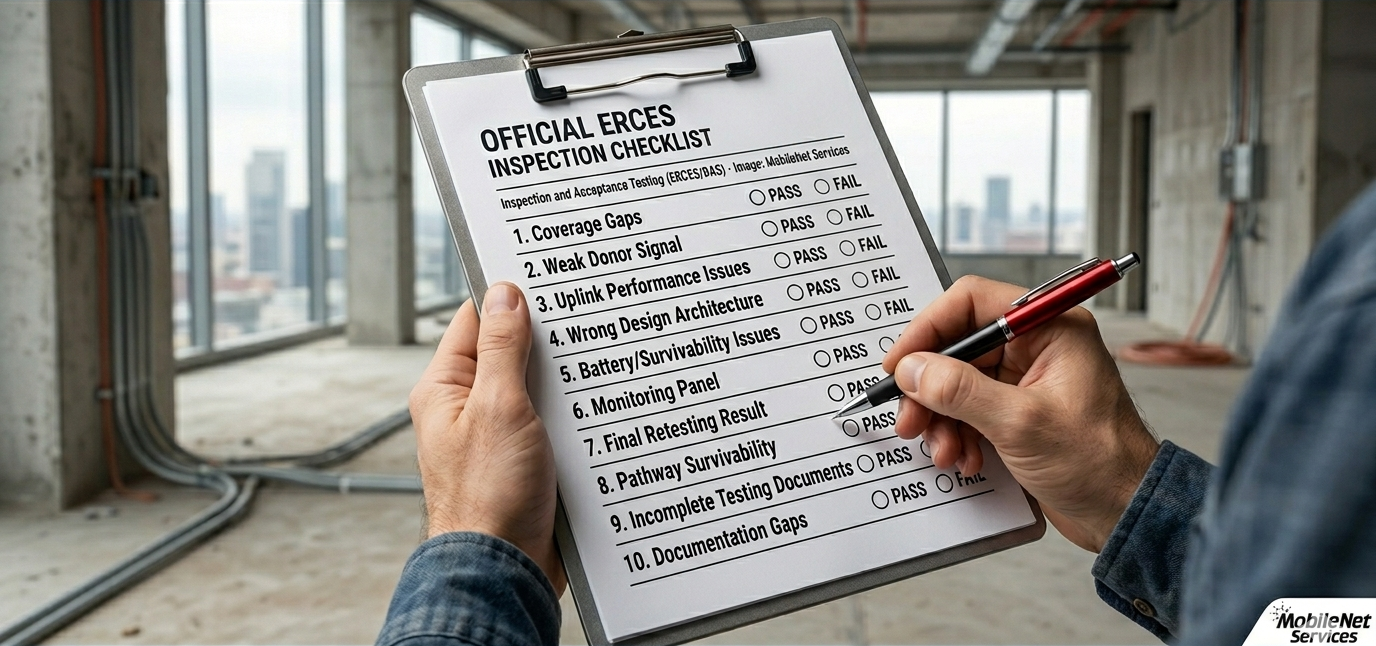
ERCES inspection checklist and acceptance testing. Image: MobileNet Services
Emergency Responder Communication Enhancement Systems are installed for one primary reason: to help first responders maintain reliable radio communication inside buildings during an emergency. Because of that, ERCES systems are not judged only by whether they are installed. They are judged by whether they perform when tested and accepted by the Authority Having Jurisdiction.
For general contractors, owners, and project teams, a failed ERCES inspection can create serious problems late in the construction schedule. It can lead to rework, additional testing, added cost, delayed closeout, and potential impact to occupancy.
The good news is that many ERCES inspection failures are preventable. Most problems come from late planning, incomplete design information, poor understanding of the RF environment, or lack of early coordination with the AHJ.
This article explains why ERCES systems fail inspection and how project teams can reduce that risk before it becomes a late stage issue. For a broader foundation, see our guide on ERCES requirements, costs, and compliance.
Table of Contents
1. Why an ERCES Inspection Failure Matters
2. Coverage Gaps Inside the Building
3. Weak or Unreliable Donor Signal
6. Battery, Survivability, and Monitoring Issues
7. Incomplete Testing or Closeout Documentation
Why an ERCES Inspection Failure Matters
ERCES is often discovered late because it can be misunderstood as a specialty low voltage scope that can be handled near the end of construction. In reality, public safety radio coverage is a code driven life safety requirement that can affect design, pathways, power, fire alarm coordination, room requirements, cabling, testing, and final approval.
When an ERCES system fails inspection, the project team may need to investigate RF performance, adjust antenna locations, replace or add equipment, revise cabling, coordinate additional AHJ review, and schedule retesting. These issues can become especially painful when they occur near substantial completion or final occupancy.
ERCES inspection failure is rarely just a technical issue. It is usually a schedule risk, cost risk, and closeout risk.
1. Coverage Gaps Inside the Building
One of the most common reasons ERCES systems fail inspection is simple: the system does not provide adequate radio coverage throughout the required areas of the building.
Coverage problems can occur in stairwells, elevators, mechanical rooms, parking areas, basements, long corridors, shielded rooms, and other areas where building materials or layout reduce signal levels.
Common Causes of Coverage Gaps
- Insufficient antenna density
- Poor antenna placement
- Unaccounted building materials that block or weaken RF signal
- Changes in wall layout or ceiling conditions after design
- Assumptions made before a proper coverage assessment
Coverage gaps are especially difficult when they are discovered after ceilings are closed, cable pathways are congested, or access to work areas is limited.
How to Avoid It
Perform an early coverage assessment and use the results to guide the system design. The design should be based on actual field conditions, not only square footage or generic antenna spacing assumptions.
2. Weak or Unreliable Donor Signal
ERCES systems are typically built around a donor antenna that receives public safety radio signal from the outside network. The BDA then amplifies and distributes that signal throughout the building.
If the donor signal is weak, unstable, obstructed, or not properly evaluated, the system may struggle to perform. A system cannot reliably distribute what it cannot properly receive.
Common Donor Signal Problems
- Weak outdoor signal at the building location
- Poor donor antenna placement
- Nearby obstructions or terrain issues
- Incorrect donor site assumptions
- Changes in the RF environment over time
Donor signal issues can affect both design feasibility and system performance. If they are not identified early, they can create major problems during commissioning and final acceptance testing.
How to Avoid It
Verify donor signal conditions before finalizing the design. This includes evaluating the available public safety bands, donor site direction, signal strength, signal quality, and practical donor antenna mounting options.
3. Uplink Performance Issues
ERCES is not only about pushing signal into a building. First responder radios must also be able to communicate back out through the system.
Uplink performance is one of the most overlooked risks in ERCES design. A system may appear acceptable from a downlink perspective but still create communication issues if the uplink path is weak, noisy, or poorly balanced.
Why Uplink Gets Missed
- Design focus is placed too heavily on downlink coverage
- Long cable runs create excessive loss
- Passive distribution is pushed beyond practical limits
- Noise, isolation, and gain settings are not properly managed
- System balancing is left too late
How to Avoid It
Treat uplink performance as a design requirement from the beginning. Proper system architecture, cable loss management, BDA configuration, antenna placement, and commissioning are all critical to reliable two way communication.
4. Wrong Design Architecture
Not every building should be treated the same way. Some buildings can be served effectively with a passive DAS approach. Others may require a hybrid architecture using fiber transport to reduce long coaxial runs and improve RF performance.
A common mistake is forcing a simple passive design onto a building that is too large, too complex, or too challenging from an RF standpoint. That decision may look less expensive at first, but it can create larger issues during testing and inspection.
For a deeper comparison of system architecture options, see our article on passive vs hybrid ERCES DAS design.
Warning Signs That the Design May Be Undersized
- Large floor plates
- Multiple wings or separated building areas
- Long cable runs from the head end
- High rise or vertically complex layouts
- Weak donor signal that requires better distribution efficiency
How to Avoid It
Select the architecture based on building conditions, not preference. The right approach should account for cable losses, uplink performance, donor signal, AHJ expectations, and practical installation constraints.
5. Battery, Survivability, and Monitoring Issues
ERCES inspection is not limited to RF coverage. The system must also meet applicable requirements for backup power, survivability, monitoring, and fire alarm interface, as required by the adopted code and local AHJ.
These items can become inspection issues when they are not coordinated early with electrical, fire alarm, low voltage, and construction teams.
Common Issues
- Backup power runtime does not match AHJ requirements
- Required monitoring points are not provided or landed correctly
- Dedicated power is not available at the head end
- Pathway survivability is not addressed
- Head end room requirements are missed or misunderstood
How to Avoid It
Confirm local AHJ requirements early. The project team should verify backup power expectations, fire alarm monitoring requirements, circuit needs, grounding, pathway requirements, and room conditions before installation begins.
6. Incomplete Testing or Closeout Documentation
Even if the system performs properly, incomplete documentation can slow down acceptance. ERCES closeout often requires clear test results, design documentation, equipment information, battery calculations, monitoring details, and AHJ specific forms or records.
Documentation gaps can make it harder for the AHJ to verify that the system was designed, installed, and tested correctly.
Common Documentation Problems
- Incomplete grid testing results
- Missing as built drawings
- Missing equipment data sheets
- Unclear battery calculations
- Unresolved AHJ comments
- Incomplete commissioning records
How to Avoid It
Treat documentation as part of the scope, not an afterthought. Closeout requirements should be identified early and tracked throughout design, installation, commissioning, and final inspection.
7. Late AHJ Coordination
Every jurisdiction can have its own expectations for ERCES review, testing, documentation, and acceptance. Even when the base code is similar, local interpretation can vary.
Waiting until the end of the project to coordinate with the AHJ can create avoidable problems. The project team may discover that additional bands are required, certain equipment types are expected, documentation needs are different, or testing procedures must follow a specific process.
How Late AHJ Coordination Creates Risk
- Design assumptions may not match local requirements
- Required frequencies may not be fully confirmed
- Inspection expectations may be misunderstood
- Approval timelines may not align with the project schedule
- Revisions may be needed after installation has already started
How to Avoid It
Engage the AHJ early and document the direction received. Early coordination helps reduce uncertainty and gives the design team a clearer path to approval.
How to Avoid ERCES Inspection Failure
Avoiding ERCES inspection failure starts with treating the system as a critical life safety scope, not a late stage specialty add on.
For broader preconstruction guidance, read our article on why project teams should plan public safety radio coverage early.
Best Practices for Project Teams
- Perform an early public safety radio coverage assessment
- Confirm the AHJ, adopted code, and local requirements
- Verify required public safety bands before final design
- Evaluate donor signal conditions early
- Select the right DAS architecture for the building
- Account for uplink performance, not just downlink coverage
- Coordinate power, fire alarm, grounding, pathways, and room requirements
- Plan for testing and documentation before final inspection
- Allow enough time for commissioning, adjustments, and AHJ review
These steps help reduce the likelihood of last minute redesign, additional installation work, retesting, and inspection delays.
Final Takeaway
ERCES inspection failures usually do not happen because one single item was missed. They often happen because several assumptions were made too early and several critical details were addressed too late.
The most common causes include coverage gaps, weak donor signal, uplink problems, wrong design architecture, missing backup power or monitoring coordination, incomplete documentation, and late AHJ engagement.
For general contractors, owners, and preconstruction teams, the best way to reduce ERCES risk is to identify the requirement early, verify the RF environment, coordinate with the AHJ, and build the design around real project conditions.
How MobileNet Services Approaches It
At MobileNet Services, we support ERCES projects from early planning through final AHJ acceptance. Our process considers building conditions, donor signal availability, public safety frequency requirements, DAS architecture, code requirements, commissioning, and final inspection readiness.
By addressing these items early, project teams can reduce rework, control cost, improve system reliability, and support a smoother path to occupancy.
Need Help Evaluating ERCES Risk On Your Project?
MobileNet Services can help assess public safety radio coverage requirements, coordinate with the AHJ, and provide turnkey ERCES DAS support from design through inspection.
Contact MobileNet Services to discuss your project.