
Wireless Infrastructure for Data Centers: ERCES, Cellular DAS, and Two-Way Radio
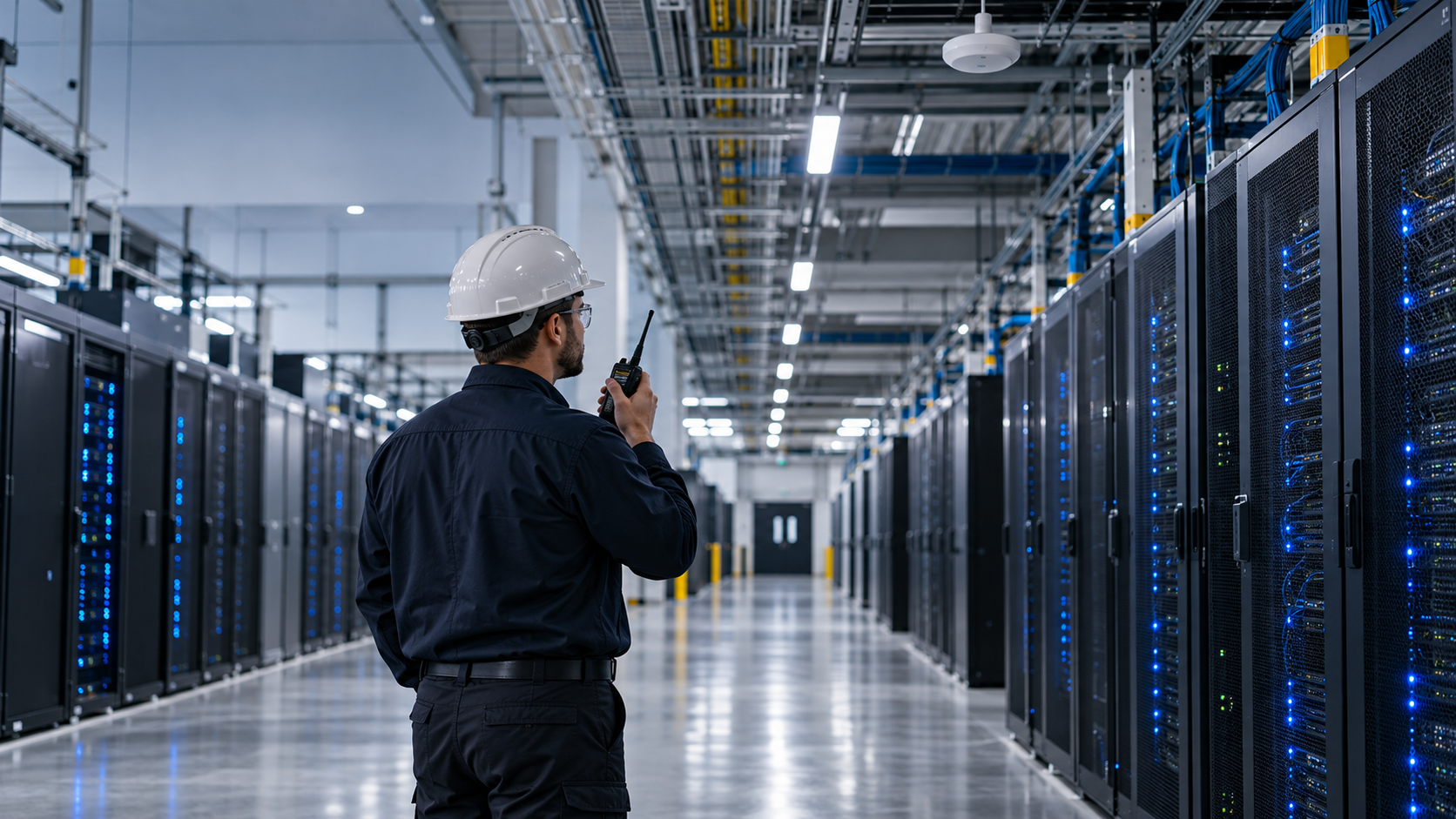
ERCES, Cellular DAS, and private two-way radio systems support different users and networks within a mission-critical facility. Image: MobileNet Services
Data centers are built around connectivity, redundancy, and uptime. Enormous attention is given to the fiber, network, and electrical infrastructure supporting the equipment inside these facilities, yet another form of connectivity can easily be overlooked during design: reliable wireless communication for the people who operate, maintain, secure, and respond to emergencies within them. A facility can have world-class network infrastructure and still contain areas where a cell phone cannot maintain reliable service, a technician’s two-way radio struggles to reach another part of the campus, or a firefighter’s portable radio cannot reliably communicate with the public safety network outside.
These represent three different wireless challenges, addressed through Cellular DAS, private two-way radio, and Emergency Responder Communication Enhancement Systems (ERCES). Each serves a different group of users and operates independently, but all three can be affected by the same characteristics that make modern data centers so complex: massive footprints, hardened construction, dense infrastructure, multiple buildings, and phased development. For mission-critical facilities, understanding these systems as part of the broader wireless infrastructure strategy can help owners and project teams plan for reliable communications throughout the life of the campus.
Table of Contents
1. Why Data Centers Are Unique Wireless Environments
2. Three Wireless Networks, Three Different Purposes
3. ERCES: Public Safety Communications
4. Cellular DAS: Commercial Cellular Connectivity
5. Two-Way Radio: Operations and Security
6. Wireless Infrastructure at Data Center Scale
7. Planning for Multi-Building and Phased Campuses
8. Why the Systems Should Be Planned Together
9. Questions to Ask During Planning
Why Data Centers Are Unique Wireless Environments
Data centers present an unusual combination of size, density, construction materials, security, and operational requirements that can make them particularly challenging environments for wireless communications. Large floor plates, reinforced concrete, structural steel, metal wall assemblies, equipment rooms, and dense mechanical and electrical infrastructure can all affect the propagation of radio frequency signals throughout the facility. At the same time, a single data center may encompass hundreds of thousands of square feet, while a hyperscale development may consist of multiple large buildings constructed over several phases. As a result, strong cellular, public safety, or private radio coverage outside the facility does not necessarily translate to reliable communications deep inside the building.
These challenges also tend to increase as the facility grows. Wireless signals must travel farther, penetrate more physical obstructions, and provide coverage across spaces with very different RF characteristics. A data hall, electrical room, stairwell, loading area, office space, and exterior yard may all behave differently from an RF perspective. This makes wireless coverage in a data center less about simply adding antennas and more about understanding how each wireless network needs to function throughout the complete facility.
Key Takeaway: Data centers are designed to protect the infrastructure inside them. Many of the same physical characteristics that provide that protection can also make them challenging environments for wireless signals.
Three Wireless Networks, Three Different Purposes
ERCES, Cellular DAS, and private two-way radio systems all address wireless coverage, but they serve different users, connect to different networks, and solve different communication problems. ERCES supports firefighters, police officers, EMS personnel, and other emergency responders using the local public safety radio network. Cellular DAS extends commercial carrier connectivity for smartphones, tablets, and other cellular devices used by employees, contractors, vendors, and visitors. Private two-way radio systems support internal operations by providing dedicated push-to-talk communications for personnel such as security officers, engineers, maintenance technicians, and operations teams.
The distinction is important because reliable coverage on one network does not establish reliable coverage on another. A facility could have excellent commercial cellular service while public safety radios encounter dead zones, or a private two-way radio system could perform well throughout the property while cellular devices struggle inside data halls and equipment spaces. Each network must therefore be evaluated according to its own frequencies, users, coverage objectives, performance requirements, and supporting infrastructure.
| Category | ERCES | Cellular DAS | Private Two-Way Radio |
|---|---|---|---|
| Primary users | Fire, police, EMS, and other emergency responders | Employees, contractors, vendors, and visitors | Security, engineering, maintenance, and operations personnel |
| Network | Local public safety radio network | Commercial cellular carrier networks | Private operational radio network |
| Primary purpose | Emergency responder communications | Indoor cellular connectivity | Facility operations and security |
| Typical devices | Public safety portable radios | Smartphones, tablets, and cellular devices | Portable and mobile radios |
| Primary consideration | Life safety and code compliance | Coverage, capacity, and user experience | Operational coverage and reliability |
ERCES: Public Safety Communications
An Emergency Responder Communication Enhancement System, or ERCES, enhances the public safety radio network inside a building when the structure prevents adequate radio coverage. For data centers, the challenge is frequently one of scale. A conventional passive system distributes RF through coaxial cable, antennas, splitters, couplers, and other passive components, all of which introduce some degree of insertion loss. As cable distances increase across an extremely large building, those losses accumulate and can make it increasingly difficult to distribute sufficient RF energy from a single centralized location.
Fiber-based or hybrid ERCES architectures can address this challenge by transporting the RF signal optically from centralized headend equipment to remote units positioned closer to the areas requiring coverage. Shorter coaxial distribution networks can then serve the antennas within each coverage zone. In a large data center, this changes an important part of the engineering question. Instead of only determining how many antennas the building requires, the design must also determine where RF should originate throughout the facility, how individual coverage zones should be established, and how the architecture can support the size and configuration of the building or campus.
For a broader introduction to public safety radio coverage and ERCES, read What Is ERCES / Public Safety DAS? Requirements, Costs, and Compliance.
Cellular DAS: Commercial Cellular Connectivity
Cellular coverage serves a different purpose but encounters many of the same physical challenges. A data center may have strong outdoor service from commercial wireless carriers while experiencing poor cellular performance indoors because the building attenuates the signals attempting to penetrate the exterior envelope. Reinforced construction, Low-E glass, metal assemblies, interior equipment, and the sheer depth of a large facility can make it difficult for outdoor cellular networks to provide consistent service throughout interior spaces.
The impact extends beyond basic phone calls and text messages. Employees, contractors, vendors, and other authorized users may rely on cellular connectivity for authentication, collaboration applications, mobile work platforms, messaging, and other business functions. A Cellular Distributed Antenna System can distribute commercial carrier signals throughout the facility to provide more consistent indoor coverage. In a large data center or multi-building campus, fiber-fed remote equipment can also provide a scalable method of extending cellular RF throughout the property while keeping individual coaxial distribution areas manageable.
Two-Way Radio: Operations and Security
Private two-way radio serves another important group within the data center: the personnel responsible for operating and protecting the facility. Security officers, facility engineers, maintenance technicians, operations teams, emergency management personnel, and construction or logistics teams may rely on portable radios for immediate push-to-talk communication. Unlike a conventional phone call, two-way radio can provide rapid one-to-one or one-to-many communication between personnel without requiring users to dial a number or depend on the commercial cellular network.
For a large or multi-building data center, however, direct portable-to-portable communication may not provide sufficient coverage throughout the entire property. Equipment rooms, reinforced walls, long distances, exterior yards, separate buildings, and other physical barriers can reduce radio performance or create dead zones. Depending on the facility’s operating requirements, repeaters, rooftop antennas, distributed indoor antennas, or other RF infrastructure may be necessary to extend the private radio network throughout the desired coverage area and maintain communications between personnel working in different portions of the campus.
For a detailed comparison between private operational radio and public safety communications, read Two-Way Radio vs ERCES: What’s the Difference?.
Wireless Infrastructure at Data Center Scale
Scale fundamentally changes the wireless design problem. In a smaller commercial building, it may be practical to locate RF equipment in a centralized room and distribute signals throughout the property primarily through coaxial cable. A 300,000-square-foot data center, a one-million-square-foot facility, or a multi-building campus presents a very different engineering challenge. Long RF distribution paths introduce additional loss, remote equipment requires power and connectivity, antenna placement must account for a wide variety of RF environments, and equipment must remain accessible for testing and maintenance without unnecessarily interfering with mission-critical operations.
As facilities grow, wireless design increasingly becomes an infrastructure problem rather than simply an antenna-placement exercise. The project team must consider not only whether coverage can be achieved, but also how signals will be transported efficiently across the facility, where active equipment should be located, how individual coverage zones will be established, and whether the architecture can accommodate future growth. These considerations can apply differently to ERCES, Cellular DAS, and private two-way radio, but the underlying challenge is similar: distributing RF efficiently across an unusually large and complex environment.
Fiber Becomes Increasingly Important
Fiber can play an important role in solving the distance problem because it can transport signals over substantial distances without the RF transmission losses associated with equivalent coaxial cable runs. Depending on the technology and system architecture, centralized equipment can feed remote RF equipment distributed throughout a building or campus, effectively bringing the RF source closer to the antennas and users it serves. This can reduce the dependence on extremely long coaxial runs and provide a more scalable architecture for large facilities, multiple floors, separate buildings, and future phases.
Planning for Multi-Building and Phased Campuses
Many data centers are not constructed as a single finished project. A campus may begin with one building or data hall and expand through additional halls, support facilities, and entirely new structures over several years. That development model creates a different challenge for wireless infrastructure because decisions made during the initial phase can influence how easily future areas can be incorporated into the overall system. A design that works well for the first building may become unnecessarily restrictive if future phases, inter-building communications, additional remote equipment, or expanded fiber distribution were never considered.
Planning Question: Are we designing only for the building being constructed today, or are we accounting for the campus that will eventually exist?
Planning for future expansion does not necessarily mean purchasing every future antenna, remote unit, amplifier, or other piece of wireless equipment during the initial phase. Instead, the project team can consider fiber capacity, equipment-room space, conduit and pathway capacity, rooftop antenna locations, remote equipment locations, inter-building connectivity, and power requirements while those elements are easier to accommodate. Once a data center becomes operational, adding infrastructure can become considerably more complicated because of security procedures, restricted access, active equipment, maintenance windows, and limitations on construction activities. Infrastructure that is relatively simple to coordinate during construction can become significantly more disruptive to install after the facility is live.
Why the Systems Should Be Planned Together
ERCES, Cellular DAS, and private two-way radio are separate wireless systems, and planning them together does not necessarily mean combining them into a common network. Their frequencies, equipment, users, performance objectives, ownership, and regulatory requirements may be very different. The advantage of coordinated planning is instead the ability to evaluate the complete wireless environment of the facility and identify where the systems have common infrastructure requirements or potential conflicts.
All three systems may require some combination of equipment-room space, rooftop antenna access, fiber infrastructure, coaxial pathways, indoor antenna locations, electrical power, grounding and bonding, conduit, sleeves, and access for future testing and maintenance. Considering these requirements collectively can help the design and construction teams reserve appropriate space, coordinate pathways, reduce unnecessary duplication, and avoid discovering late in the project that multiple wireless systems are competing for the same physical infrastructure. On a large multi-building campus, that coordination can become increasingly valuable as additional phases are constructed and the overall wireless environment continues to expand.
Key Takeaway: ERCES, Cellular DAS, and private two-way radio should be engineered as separate networks, but they do not have to be planned in isolation.
Questions to Ask During Planning
A complete wireless strategy begins by understanding who needs to communicate, which networks they depend on, where coverage is required, and how those requirements may change as the facility expands. For data center owners, developers, design teams, general contractors, and electrical contractors, the following questions can help define the scope before individual systems are designed.
Public Safety / ERCES
- Which public safety radio system serves the facility?
- Which frequencies or bands must be supported?
- What does the local Authority Having Jurisdiction (AHJ) require?
- Has public safety radio coverage been evaluated?
- Will the size or configuration of the facility require a fiber-based or hybrid architecture?
- How will future buildings or phases affect the system?
Cellular
- Which commercial carriers need to be supported?
- Where is cellular coverage currently deficient?
- Which areas require reliable cellular service?
- What coverage and capacity requirements are anticipated?
- Will future phases need to connect to the same cellular infrastructure?
Two-Way Radio
- Which departments and personnel will use the system?
- How many users and talk groups are required?
- Which indoor and outdoor areas require coverage?
- Does communication need to extend between multiple buildings?
- Will direct portable-to-portable communication be sufficient?
- Is repeater or distributed RF infrastructure required?
Frequently Asked Questions
Does Every Data Center Need All Three Systems?
No. Wireless requirements depend on the facility, operational needs, measured RF conditions, commercial carrier requirements, and applicable public safety requirements. Some data centers may require all three systems, while others may require only one or two. The important distinction is that the performance of one wireless network should not be used to assume adequate performance on another.
Can ERCES, Cellular DAS, and Two-Way Radio Share the Same Infrastructure?
Shared RF infrastructure should never be assumed. The systems can operate on different frequency bands, connect to different networks, use different equipment, and be subject to different engineering, licensing, code, monitoring, and approval requirements. However, supporting infrastructure such as equipment space, fiber capacity, conduit pathways, electrical coordination, grounding, and rooftop access can often be considered collectively during planning.
Why Is Fiber Common in Large Wireless Deployments?
Coaxial cable introduces RF loss as distance increases, which becomes increasingly important in very large buildings. Fiber can transport signals over much greater distances without comparable RF transmission losses, allowing active remote equipment to be positioned closer to the areas requiring coverage. This makes fiber particularly useful in large data centers, expansive floor plates, and multi-building campus environments.
Can Strong Outdoor Cellular Coverage Guarantee Good Indoor Coverage?
No. Strong outdoor cellular service does not guarantee that the same signals will penetrate deeply into a data center. Exterior walls, Low-E glass, concrete, structural steel, metal assemblies, interior equipment, and the physical depth of the building can all attenuate RF signals and create areas with poor indoor performance.
Can Good Cellular Coverage Replace Two-Way Radio?
Not necessarily. Cellular and private two-way radio systems serve different operational requirements. Two-way radio provides immediate push-to-talk communications and can support dedicated operational groups without requiring personnel to initiate individual phone calls. Depending on the design, a private radio system may also provide an operational communications platform that does not depend on commercial cellular coverage within the facility.
Can a Data Center Have Excellent Cellular Coverage but Poor Public Safety Radio Coverage?
Yes. Commercial cellular, private two-way radio, and public safety radio networks operate independently and may use completely different frequency bands, infrastructure, and external radio sites. Strong performance on one network does not establish adequate performance on another, which is why each wireless environment must be evaluated according to its own requirements.
Final Takeaway
Data centers are among the most connected facilities in the world, but connectivity should not stop with the servers and equipment they contain. The people responsible for operating, maintaining, securing, and responding to emergencies within these facilities also depend on reliable communications. ERCES supports firefighters, police officers, EMS personnel, and other emergency responders using the public safety radio network. Cellular DAS supports commercial cellular connectivity for people and connected devices inside the facility, while private two-way radio provides dedicated communications for security, engineering, maintenance, operations, and other facility personnel.
Each network has its own users, frequencies, infrastructure, and engineering requirements, but large and multi-building data centers provide an opportunity to think beyond individual systems and consider the facility’s overall wireless infrastructure. By evaluating these needs at the building or campus level, project teams can develop a wireless strategy capable of supporting the facility today while providing a practical path for future expansion.
How MobileNet Services Can Help
MobileNet Services provides turnkey ERCES, Cellular DAS, and private two-way radio solutions for data centers and other mission-critical environments. Our capabilities include RF testing, engineering, system design, installation, commissioning, acceptance testing, and long-term support.
Whether your project is a single data center, hyperscale facility, or multi-building campus, MobileNet can help evaluate the complete wireless environment and develop infrastructure around the facility’s public safety, cellular, and operational communication requirements. Contact MobileNet Services to discuss your data center or mission-critical wireless project.