
Two-Way Radio vs ERCES: What’s the Difference?
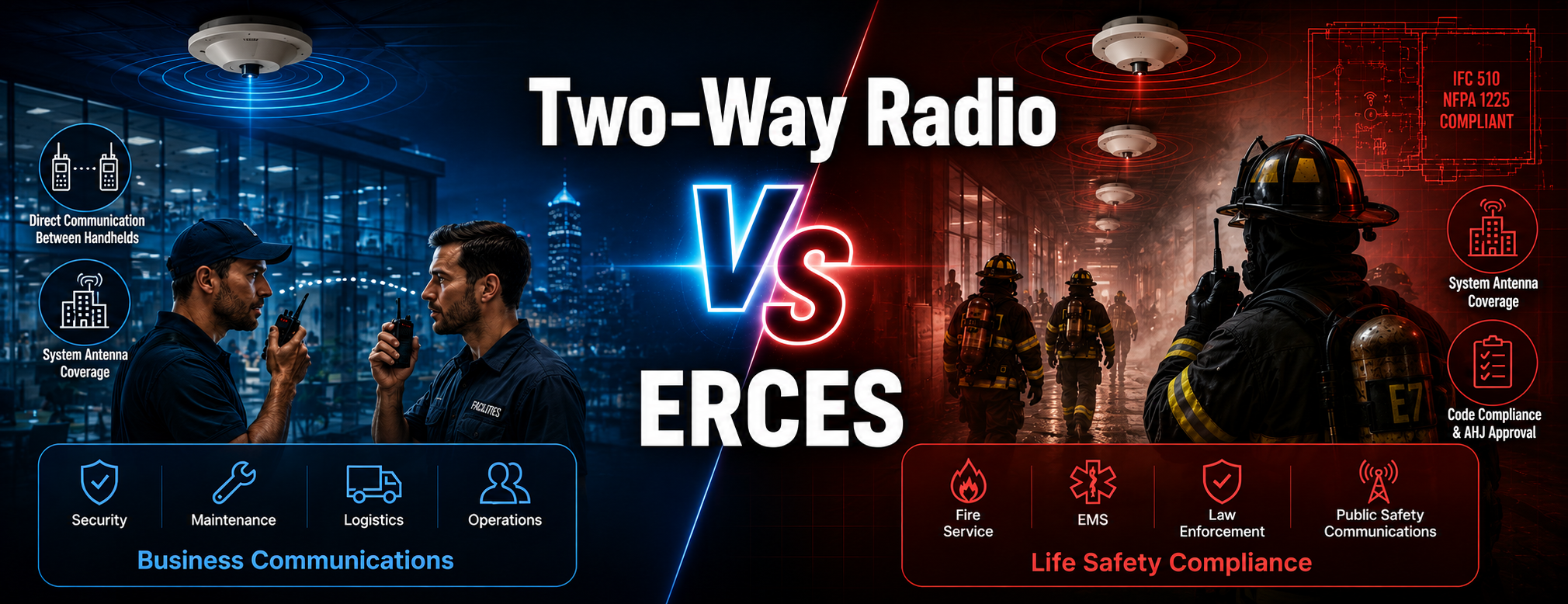
Commercial two-way radio and ERCES serve different users, networks, and communication objectives. Image: MobileNet Services
Two-way radio systems and Emergency Responder Communication Enhancement Systems (ERCES) both support wireless voice communications, but they are designed for very different users and purposes. A commercial two-way radio system supports a building’s employees and daily operations, while ERCES supports firefighters, police officers, emergency medical personnel, and other first responders using the local public safety radio network.
Table of Contents
1. A Note About the Terminology
2. What Is a Commercial Two-Way Radio System?
4. Two-Way Radio vs ERCES: Key Differences
5. How the Infrastructure Differs
6. Can One System Replace the Other?
7. When a Facility May Need Both Systems
8. Why Early Coordination Matters
9. Questions to Ask During Planning
A Note About the Terminology
Technically, ERCES also supports two-way radio communications. First responders transmit and receive over a public safety land mobile radio network, and the ERCES enhances that network inside a building.
However, within commercial construction and facility operations, the phrase two-way radio system is commonly used to describe an organization’s private operational radio system. That may include handheld radios used by security, maintenance, engineering, transportation, housekeeping, event staff, or other employees.
Key Takeaway:
A commercial two-way radio system supports the building owner’s daily operations. ERCES supports the public safety radio network used by emergency responders. Reliable coverage on one system does not prove that the other system will work.
What Is a Commercial Two-Way Radio System?
A commercial two-way radio system allows authorized employees to communicate directly through handheld, mobile, or fixed radio equipment. Users can typically communicate by pressing a push-to-talk button, making radio practical for teams that require fast and coordinated communication.
Common Users
- Security personnel
- Facilities and engineering teams
- Maintenance technicians
- School administrators and transportation staff
- Hospital operations personnel
- Manufacturing and warehouse employees
- Hotel, resort, and event staff
- Construction and logistics teams
A basic system may consist of portable radios communicating directly with one another. Larger, taller, denser, or multi-building facilities may require additional infrastructure such as a repeater, rooftop antenna, duplexer, distributed indoor antennas, coaxial cable, fiber-fed remote equipment, or dispatch consoles.
Typical Objectives
- Provide reliable staff communication throughout the property
- Support routine security, maintenance, and facilities activities
- Connect multiple departments or employee groups
- Extend communication between buildings and outdoor areas
- Improve coordination during internal incidents or disruptions
- Reduce dependence on cellular service for routine operations
The organization typically owns or controls the radio equipment, selects the intended user groups, establishes operating procedures, and maintains the system. Depending on the frequency band and configuration, Federal Communications Commission licensing or frequency coordination may also be required.
What Is ERCES?
ERCES stands for Emergency Responder Communication Enhancement System. It is an in-building radio enhancement system intended to maintain reliable communications for emergency responders when the building’s construction or configuration weakens the outdoor public safety radio signal.
ERCES is also commonly referred to as Public Safety DAS, an emergency responder radio coverage system, ERRCS, or a BDA system, although the bi-directional amplifier is only one component of many ERCES designs.
Modern building materials can significantly reduce radio signals. Reinforced concrete, metal decking, low-emissivity glass, below-grade rooms, stairwells, elevator cores, mechanical spaces, and complex floorplans may create locations where responders cannot communicate reliably with the outdoor public safety radio network.
When required by the adopted fire code, local amendments, or the Authority Having Jurisdiction (AHJ), a building may need to be tested for emergency responder radio coverage. If the building does not meet the applicable coverage criteria, an ERCES may be required as the engineered solution.
For a broader introduction, read What Is ERCES / Public Safety DAS? Requirements, Costs, and Compliance.
Typical ERCES Components
- A rooftop donor antenna aimed toward an approved public safety radio source
- Bi-directional amplifier or signal booster equipment
- Radio frequency filtering
- Coaxial cable, fiber, splitters, tappers, couplers, and indoor antennas
- Battery backup and dedicated power
- System monitoring and alarm annunciation
- Protected pathways or survivability measures
- Commissioning, acceptance testing, and closeout documentation
Two-Way Radio vs ERCES: Key Differences
| Category | Commercial Two-Way Radio | ERCES / Public Safety DAS |
|---|---|---|
| Primary purpose | Supports routine business and facility operations | Supports emergency responder communications inside the building |
| Primary users | Security, maintenance, facilities, transportation, operations, and other employees | Firefighters, police officers, EMS personnel, and other authorized responders |
| Network | A private or business radio network established for the organization | The jurisdiction’s public safety radio network |
| Typical trigger | An operational need for reliable employee communication | Insufficient in-building public safety coverage or a jurisdictional testing requirement |
| Approval | Owner or operator, along with applicable FCC licensing requirements | AHJ and, where applicable, the public safety radio system license holder |
| Testing | Operational coverage and functional testing | Code-driven grid testing, commissioning, and formal acceptance procedures |
A commercial two-way radio system belongs to the organization’s operations. ERCES belongs to the building’s public safety and life safety strategy.
How the Infrastructure Differs
The systems can appear similar because both may distribute radio signals throughout a building. However, the equipment selection, frequencies, performance criteria, approval process, and installation requirements are not interchangeable.
Commercial Two-Way Radio Infrastructure
A commercial system may use direct portable-to-portable communication, a conventional repeater, trunked radio architecture, digital mobile radio technology, or another configuration selected around the organization’s coverage, capacity, privacy, and operational requirements.
A repeater receives a transmission on one frequency and retransmits it on another, typically from a more advantageous antenna location. This can extend coverage and allow portable radios to communicate across larger buildings or campuses where direct radio-to-radio operation is not sufficient.
ERCES Infrastructure
ERCES is engineered specifically to enhance an existing public safety radio network inside the building. Its design must account for donor signal conditions, uplink and downlink performance, system isolation, RF filtering, antenna density, cable losses, pathway routing, backup power, monitoring, and the AHJ’s acceptance criteria.
Because ERCES interacts with an active public safety network, an improperly designed system can create interference, oscillation, excessive noise, or other conditions that affect communications beyond the building itself.
The distribution architecture may be passive or hybrid depending on the project. For more information, read ERCES DAS Design: Passive vs Hybrid.
Can One System Replace the Other?
Can a Commercial Two-Way Radio System Replace ERCES?
No. Providing radios to building employees does not improve the coverage available to responding firefighters or police officers. First responders arrive with agency-issued radios programmed for their jurisdiction’s public safety network.
If the building fails the required public safety radio coverage test, adding employee radios or installing a private business repeater does not correct that deficiency.
Can ERCES Replace a Commercial Two-Way Radio System?
No. ERCES is not intended to serve as the building’s routine employee communication system. It is designed for authorized public safety users and designated emergency responder frequencies.
Does a Cellular DAS Replace Either System?
No. A commercial cellular Distributed Antenna System improves cellular service for phones and connected devices. It does not automatically enhance a private land mobile radio network or the jurisdiction’s public safety radio system.
- Commercial cellular coverage
- Private two-way radio coverage for employees
- ERCES coverage for emergency responders
When a Facility May Need Both Systems
A facility may have excellent ERCES coverage but poor communication between its own employees. The opposite can also occur: staff radios may work reliably throughout the site while emergency responder radios fail in stairwells, basements, mechanical areas, or other portions of the building.
Hospitals and Healthcare Campuses
Hospitals often depend on private radios for security, engineering, environmental services, patient transport, parking operations, and emergency management. At the same time, fire, police, and EMS personnel require reliable coverage on the local public safety network.
Schools and Educational Campuses
Administrators, security personnel, transportation teams, coaches, and facilities staff may rely on private radio communications across classrooms, athletic areas, parking lots, and multiple buildings.
Manufacturing and Industrial Facilities
Operations teams may need radio coverage across production areas, warehouses, yards, loading docks, and exterior storage areas. The same construction may also reduce public safety radio signals entering the building.
Hotels, Data Centers, and Large Commercial Campuses
Large, complex, shielded, or multi-building properties often create separate coverage challenges for employees and emergency responders, making it important to evaluate both networks independently.
Why Early Coordination Matters
Although commercial two-way radio and ERCES are separate systems, planning them independently can create infrastructure conflicts, duplicated work, and expensive late-stage changes.
Early Coordination Can Help Project Teams
- Reserve appropriate equipment-room space
- Coordinate rooftop antenna locations
- Plan risers, sleeves, conduits, and pathways
- Coordinate dedicated power and battery backup requirements
- Avoid indoor antenna placement conflicts
- Evaluate potential radio frequency interaction
- Clarify conduit, firestopping, grounding, and monitoring responsibilities
- Plan field testing around the construction schedule
- Reduce duplicated site visits and disruptive retrofit work
Coordination does not necessarily mean combining the systems into one network. In most cases, they should remain separate.
It means evaluating the complete in-building wireless environment so each network can perform as intended.
Our article Public Safety Radio Coverage: Plan Early or Pay Later explains why radio coverage should be addressed before it becomes a closeout problem.
Questions to Ask During Planning
Questions for a Commercial Two-Way Radio System
- Which departments and employees will use the radios?
- How many portable or mobile radios are required?
- Which indoor and outdoor areas require coverage?
- Does communication need to extend between multiple buildings?
- Are separate channels or talk groups required?
- Will direct radio-to-radio communication be sufficient?
- Is a fixed repeater or distributed antenna system needed?
- What FCC licensing or frequency coordination applies?
Questions for ERCES
- Which fire code edition and local amendments have been adopted?
- What does the local AHJ require for coverage testing?
- Which public safety bands and technologies must be supported?
- Who is the applicable frequency license holder?
- What backup runtime, pathway survivability, and monitoring requirements apply?
- When should grid testing occur relative to building enclosure and ceiling installation?
- Who is responsible for design, permitting, installation, commissioning, and acceptance testing?
For more information about the testing process, read ERCES Grid Testing Explained: What Fire Marshals Are Looking For.
Frequently Asked Questions
Does installing employee radios satisfy ERCES requirements?
No. Employee radio systems and ERCES support different users and different radio networks. A private business radio system does not improve emergency responder coverage on the public safety radio network.
Can an ERCES also be used by building employees?
ERCES is designed to support authorized public safety radio communications. It is not intended to replace a commercial two-way radio system used for day-to-day building operations.
Does every building require an ERCES?
No. Requirements depend on the adopted fire code, local amendments, AHJ requirements, and the building’s measured public safety radio coverage. Buildings that do not meet the applicable coverage criteria may require an ERCES.
Can a Cellular DAS satisfy ERCES requirements?
No. A cellular DAS improves commercial cellular service but does not automatically enhance the jurisdiction’s public safety radio system or satisfy ERCES requirements.
Final Takeaway
Commercial two-way radio systems and ERCES both support wireless communications, but they are designed for different users, different radio networks, and different objectives. One supports the daily operations of a facility, while the other helps emergency responders maintain reliable communications during critical incidents.
Understanding that distinction early allows project teams to plan appropriate infrastructure, avoid costly redesigns, coordinate more effectively with the AHJ, and provide reliable communications for both employees and first responders.
How MobileNet Services Can Help
MobileNet Services provides turnkey commercial two-way radio, Cellular DAS, and ERCES DAS solutions, including RF engineering, system design, wireless testing, installation, commissioning, acceptance testing, and long-term support for healthcare, education, commercial, industrial, mission critical, and multi-building campus environments.
Whether your project requires a private operational radio system, public safety radio coverage testing, an ERCES deployment, or a coordinated campus-wide wireless strategy, Contact MobileNet Services to discuss your project.