
What Is ERCES / Public Safety DAS? Requirements, Costs, and Compliance
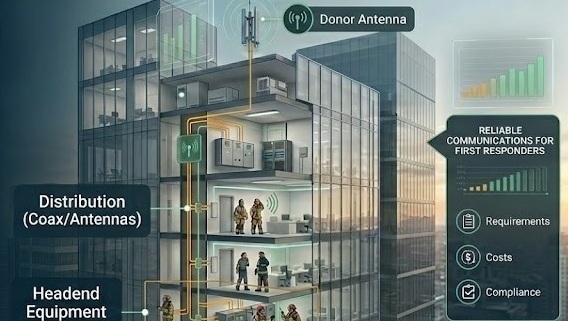
ERCES public safety radio system requirements and compliance planning. Image: MobileNet Services
ERCES, also referred to as Public Safety DAS or an Emergency Responder Communication Enhancement System, is one of the most misunderstood life safety scopes in commercial construction. Most teams know it has something to do with firefighter radios, but the real impact is bigger: it can influence space planning, pathways, electrical loads, testing schedules, and the final acceptance process.
This guide breaks down what ERCES is, when it’s commonly required, the major compliance expectations project teams should plan for, and what typically drives cost so you can avoid scope gaps and late-stage surprises. Many Texas projects also run into AHJ specific preferences on testing and acceptance, so early alignment matters.
Table of Contents
1. What ERCES / Public Safety DAS Is
2. How an ERCES System Is Typically Built
2.1 Headend: BDA, Donor Antenna, Filters
2.2 Distribution: Remotes, Coax/Fiber, Antennas
3. When ERCES Is Commonly Required
4. Key Compliance Requirements That Drive Design
6. A Practical Timeline That Avoids Inspection Delays
8. FAQ
What ERCES / Public Safety DAS Is
ERCES (Emergency Responder Communication Enhancement System) is an in-building radio enhancement system intended to maintain reliable first responder radio communications inside a structure. It’s typically enforced by the local AHJ (Authority Having Jurisdiction) and often tied to International Fire Code adoption and local amendments.
In practical terms, ERCES exists to solve a common problem: many modern buildings block public safety radio signals due to construction materials, energy-efficient glass, underground areas, and complex floorplans. When a building fails radio coverage testing, ERCES becomes the engineered fix.
How an ERCES System Is Typically Built
While system architecture varies by building and jurisdiction, most ERCES systems include four major building blocks: headend equipment, in-building distribution, power with backup runtime, and monitoring and annunciation.
Headend: BDA, Donor Antenna, Filters
The headend is where the outside public safety signal is received and amplified for indoor distribution. A donor antenna mounted on the roof captures the off-air signal from the responding agencies and feeds it via coax cable into the headend. The signal then passes through the BDA (bi-directional amplifier) where it is amplified and filtered before being distributed throughout the building’s RF network. In many systems, this distribution occurs through coaxial infrastructure including splitters, tappers, and indoor antennas, while in larger buildings fiber may also be used to extend the signal to remote locations before final RF distribution.
Distribution: Remotes, Coax/Fiber, Antennas
The distribution layer delivers the amplified signal throughout the building using coaxial pathways, fiber backbones, remote units, splitters, couplers, taps, and antennas placed to achieve coverage requirements.
Power + Backup: Batteries and Runtime
Backup runtime requirements are often a major scope driver. Batteries, cabinets, and charger equipment can add significant footprint and electrical needs.
Monitoring + Annunciation
Many AHJs require system monitoring and annunciation so faults are visible to building staff or at the fire command location.
When ERCES Is Commonly Required
ERCES is commonly triggered when a building fails public safety radio coverage testing or when local code adoption requires testing for certain occupancies or building characteristics.
- Hospitals and medical office buildings
- High-rise commercial buildings
- Large schools and campuses
- Assembly venues and large retail
- Buildings with extensive below-grade areas
- Structures with RF-blocking construction materials
What Drives ERCES Cost
ERCES cost is rarely just the equipment. The biggest cost drivers are usually infrastructure and constraints.
- Building size and complexity
- RF blocking materials
- Pathway and riser constraints
- Battery runtime requirements
- Distribution zones and antenna density
- Commissioning and testing
A Practical Timeline That Avoids Inspection Delays
- Early Design Development (DD): confirm AHJ expectations
- Late Design Development (DD) / Construction Drawings (CD): reserve headend space and pathways
- Construction: coordinate installation
- Closeout: schedule acceptance testing
Preconstruction Checklist
- Confirm AHJ testing requirements
- Identify headend location
- Clarify battery runtime expectations
- Define responsibility for conduit and pathways
- Plan acceptance testing documentation
FAQ
What does ERCES stand for?
ERCES stands for Emergency Responder Communication Enhancement System.
Is ERCES required in Texas?
Many Texas jurisdictions require public safety radio coverage testing and will require ERCES if coverage thresholds are not met.
How much does an ERCES system cost?
Cost depends on building size, materials, infrastructure requirements, and battery runtime.
Need Help Scoping ERCES?
MobileNet Services supports owners, GCs, and design teams with early-phase planning and scope clarification so ERCES doesn’t become a late-stage schedule surprise.
Contact MobileNet Services to get started.
This article summarizes common ERCES / Public Safety DAS planning considerations. Because code interpretation and acceptance criteria vary by AHJ, requirements should always be verified with the local AHJ and the project design team.