
Public Safety Radio Coverage: Plan Early or Pay Later
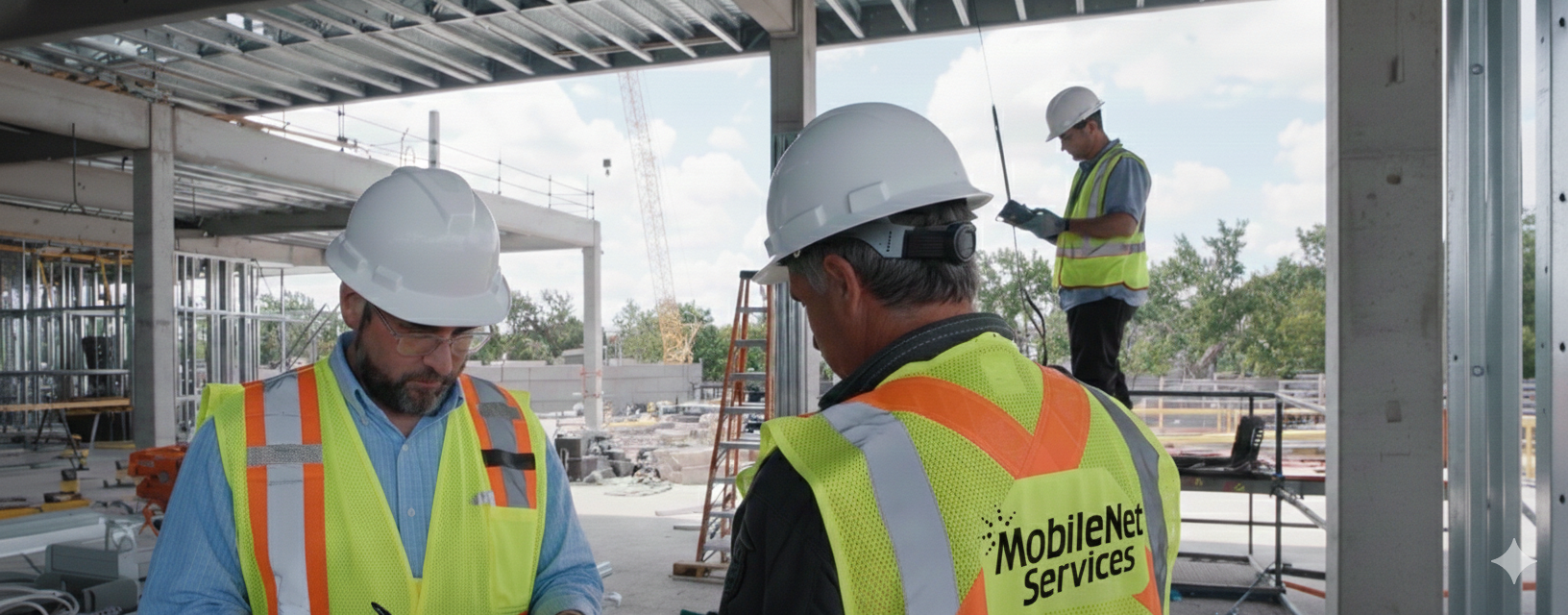
Public safety radio coverage testing and compliance planning. Image: MobileNet Services
Public Safety DAS isn’t a last-minute add-on. It’s a code-driven life safety requirement that can affect permitting, inspection, and Certificate of Occupancy timelines. When ERRCS (Emergency Responder Radio Communication System) is addressed early, it is predictable and manageable. When it is addressed late, it becomes expensive, disruptive, and high-risk.
In this article, we’ll walk through when ERRCS should be addressed in the construction timeline, including Schematic Design (SD) vs Design Development (DD) vs Construction Documents (CD), why waiting increases costs, and how to avoid the “scope gap” issue where ERRCS falls between trades.
Table of Contents
1. What Is ERRCS / Public Safety DAS?
2. When Should ERRCS Be Addressed?
3. Why Waiting Increases Cost and Schedule Risk
4. Where ERRCS Falls Between Trades (And Why It Causes Problems)
What Is ERRCS / Public Safety DAS?
ERRCS (also commonly referred to as Public Safety DAS) is an in-building radio coverage system designed to ensure first responders maintain reliable radio communications inside a building. The system is required in many jurisdictions under IFC 510 and related standards, but the exact requirements vary by AHJ (Authority Having Jurisdiction).
In most cases, compliance includes radio coverage testing, performance thresholds, battery backup requirements, and monitoring/annunciation expectations. Some jurisdictions also require pathway survivability, which can impact cabling, risers, and overall infrastructure design.
Because ERRCS is code-enforced, it can directly affect permitting, fire inspections, and final CO timelines. In other words, ERRCS becomes a schedule driver when it isn’t planned early.
When Should ERRCS Be Addressed?
Phase 1: Schematic Design (SD)
SD is the earliest and best time to identify whether ERRCS will be required and establish design intent. At this stage, the building layout is still flexible, and the cost of coordination changes is minimal. Even if the ERRCS system is not fully engineered in SD, it should absolutely be acknowledged so key needs aren’t missed.
During SD, the goal is to confirm whether IFC 510 is adopted and actively enforced in the jurisdiction, and whether the building is likely to fail radio testing based on size, construction materials, or below-grade areas. This is also when the team should discuss whether the project may require extended battery backup runtime, and whether a dedicated telecom/ERRCS headend room is being planned.
Why SD matters: If ERRCS isn’t acknowledged early, projects often advance with no dedicated space, no electrical planning, no pathway planning, and no budget placeholder. That creates surprise scope later, when changes cost more and schedule flexibility is limited.
Phase 2: Design Development (DD)
DD is where ERRCS should begin transitioning from a concept into a defined scope. This phase is when architectural and MEP coordination becomes more detailed, which means it’s the right time to reserve infrastructure and align the project team around what ERRCS will actually require.
In DD, projects should start clarifying pathway needs (risers, fire-rated routes, survivability requirements), determining whether the solution is likely passive, active, or hybrid DAS, and identifying antenna distribution zones. Electrical requirements and grounding/bonding should also be aligned during DD, along with confirming where the monitoring panel or annunciator will be located, since that often ties into the Fire Command Room depending on AHJ.
Why DD matters: This is where most projects begin value engineering. If ERRCS hasn’t been scoped properly, it becomes incomplete or “value engineered out,” which usually leads to change orders and rushed corrections later.
Phase 3: Construction Documents (CD)
CD is the last realistic phase to fully integrate ERRCS into the project without creating schedule risk. By this stage, the objective isn’t just acknowledgement, it’s clarity. If scope clarity is missing in CDs, bidding will be incomplete and installation will almost always require change orders.
In CDs, the project team should confirm AHJ requirements based on local precedent, finalize equipment room needs and electrical loads, and clarify the documentation deliverables needed for acceptance. This also includes clearly assigning responsibilities for acceptance testing coordination and turnover documentation.
Why CD matters: If ERRCS scope remains unclear in CD, the project becomes vulnerable to scope gaps, change orders, and inspection delays.
Why Waiting Increases Cost and Schedule Risk
Late-stage ERRCS design and installation typically creates additional cost and risk because the project has fewer options and less flexibility. ERRCS is heavily tied to infrastructure, pathways, power, headend space, commissioning, and acceptance testing. When those elements get addressed late, the project is forced into premium labor, rushed procurement, and rework.
Common impacts include schedule compression pricing, field conflicts with other trades, conduit/pathway rework, ceiling access disruption in finished areas, procurement delays for batteries and monitoring equipment, and higher likelihood of failing the first acceptance attempt.
Most importantly, delays tied to ERRCS can directly impact final inspection and CO timelines.
Where ERRCS Falls Between Trades (And Why It Causes Problems)
ERRCS often becomes a “gray zone” scope between trades, which leads to scope gaps, change orders, schedule delays, and inspection failures. This usually happens because teams assume “someone else owns it.”
The most common disconnect is confusion around whether ERRCS is owned by the electrical contractor, low voltage/telecom, the fire alarm scope, or a specialty integrator. Even when an integrator is hired, there may still be uncertainty about who provides conduit, pathway, grounding, power, terminations, and testing coordination.
Best practice: Treat ERRCS as a dedicated scope with defined coordination between GC/CM, EC, fire alarm contractor, and the ERRCS integrator.
Final Takeaway
ERRCS is one of the most overlooked life safety scopes because it often feels invisible until the very end of a project, when coverage testing and final inspections begin. The safest approach is to treat public safety DAS coverage not as a nice-to-have, but as a NEED-TO-HAVE life safety requirement, and address it during SD and DD, not at the end of CDs or during construction. Early planning helps eliminate scope gaps, reduces rework and change orders, and prevents cost overruns and schedule delays caused by issues that were overlooked during the planning phase.
Need Help Verifying ERRCS Requirements Early?
MobileNet Services supports project teams with early-phase budget pricing, constructability input, scope clarification, and trade coordination support. We also help teams plan for testing, commissioning, and acceptance so final inspections don’t turn into surprises.
If you’d like, we can discuss your project and help determine the best time to engage ERRCS based on jurisdiction, building type, and timeline.
Contact MobileNet Services to get started.
This article summarizes common ERRCS / Public Safety DAS compliance considerations to support early project planning.
Because code interpretation and acceptance criteria vary by AHJ, requirements should always be verified with the
local AHJ and the project design team.