
ERCES DAS Design: Passive vs Hybrid
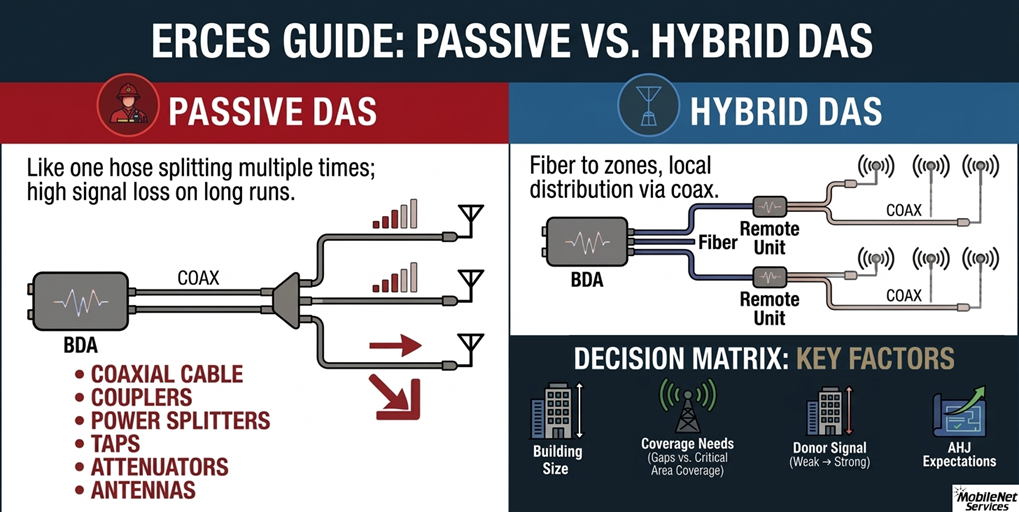
ERCES public safety radio system requirements and compliance planning. Image: MobileNet Services
When planning an Emergency Responder Communication Enhancement System, one of the most important design decisions is how RF signal is distributed throughout the building. While some discussions reference passive, hybrid, and active DAS, in real world ERCES deployments the architecture almost always comes down to a BDA based system using either passive coaxial distribution or a hybrid approach that incorporates fiber for signal transport.
Table of Contents
1. Why Architecture Matters in ERCES Design
4. Why Active DAS Is Rare in ERCES
Why Architecture Matters in ERCES Design
Choosing the wrong DAS architecture can create coverage gaps, weak uplink performance, inspection issues, and unnecessary cost. Choosing the right one early helps reduce rework, improve system reliability, and keep the project on track.
If you have not already read our earlier articles, they provide important context on why early planning matters and what ERCES involves from a compliance and budgeting standpoint: Public Safety Radio Coverage: Plan Early or Pay Later and What Is ERCES / Public Safety DAS? Requirements, Costs, and Compliance.
This article builds on those topics by focusing on a question that often comes up once a project begins taking shape: what type of signal distribution architecture should actually be used?
In ERCES, systems are fundamentally built around a bi-directional Amplifier receiving signal from a donor antenna. The real design question is how that amplified RF signal is distributed throughout the building, not whether a fully active DAS should be used.
Passive DAS: Simple and Cost Effective for Smaller Buildings
A passive DAS distributes RF signal entirely over coaxial infrastructure using splitters, taps, couplers, and antennas. Signal received at the donor antenna is amplified by the BDA and then distributed throughout the building via coaxial cable.
Where Passive DAS Works Well
- Smaller buildings
- Simpler floor plans
- Projects with strong donor signal
- Buildings with limited floor count and shorter cable runs
Advantages of Passive DAS
- Lower upfront cost
- Straightforward installation approach
- Fewer active field components to power and maintain
Limitations of Passive DAS
- Signal loss increases with cable length and each split in the system
- Uplink performance can become a concern as the system grows
- Large or complex buildings can push passive distribution beyond its practical limits
Passive DAS can be an effective solution when the building is relatively compact and the RF conditions are favorable. It is often the right choice for straightforward ERCES deployments where long cable runs and excessive losses are not major concerns.
Hybrid DAS: A Practical Solution for Larger or More Complex Buildings
A hybrid DAS still relies on a BDA as the signal source, but uses fiber to transport RF signal over long distances within the building. That signal is then converted back to RF and distributed locally using passive coaxial components.
Where Hybrid DAS Works Well
- Mid size to large buildings
- Multi wing facilities
- High rise or vertically complex buildings
- Projects where both performance and cost control matter
- Buildings where a fully passive system would be stretched too far
Advantages of Hybrid DAS
- Reduces long coaxial runs and related signal loss
- Improves uplink and downlink performance where it matters most
- Can be more practical and scalable for large floor plates or multi building style layouts
- Offers strong flexibility for larger buildings without forcing the entire system to remain coax only
Limitations of Hybrid DAS
- Requires more thoughtful design and coordination
- Introduces additional equipment and conversion points
- Still involves passive loss on the local distribution side
In many ERCES deployments, hybrid DAS provides the best balance of cost, scalability, and RF performance. It often solves the practical limitations of a purely passive system while remaining aligned with how ERCES systems are actually deployed in the field.
Why Active DAS Is Rare in ERCES
While fully active DAS architectures exist in commercial cellular systems, they are rarely deployed for ERCES.
Public safety systems are typically designed around BDA based architectures that amplify existing radio signals rather than generating or sourcing signal directly from a base station.
Because of this, most ERCES designs focus on optimizing signal distribution using passive or hybrid approaches rather than implementing a fully active DAS.
What Actually Drives the Right Decision
The choice between passive and hybrid distribution should not be based on habit or preference. It should be based on the actual project conditions.
1. Building Size and Layout
As the floor area grows and layouts become more complex, distribution losses and system coordination become more difficult. Multiple wings, long corridors, and vertical distribution paths can quickly change what architecture makes sense.
2. Donor Signal Strength
Outdoor donor signal conditions play a major role in system design. If the available signal is weak, distribution efficiency becomes even more important, which can favor hybrid solutions.
3. Uplink Performance
ERCES is not only about delivering signal into the building. The system must also support reliable communication back out from first responder radios. Uplink issues are one of the most overlooked risks in poorly planned systems.
4. AHJ Expectations
Some jurisdictions are more demanding than others when it comes to survivability, documentation, and test performance. The architecture should support not only theoretical coverage but also a successful path through inspection and acceptance.
5. Future Scalability
Hospitals, campuses, and large commercial properties often evolve over time. A design that works today should also account for the potential need to expand, modify, or support future building changes.
The Most Common Mistake
One of the most common problems in ERCES design is forcing a passive DAS approach onto a building that really calls for hybrid distribution.
That decision may appear to save money at first, but it often creates larger issues later, including:
- Coverage gaps in critical areas
- Weak uplink performance
- Failed grid testing
- Costly late stage redesign or field modifications
- Schedule impact near final inspection or occupancy
What looks like savings on paper can easily become added project risk once installation and testing begin.
Final Takeaway
There is no universal answer for ERCES DAS design.
- Passive DAS works well for smaller and simpler buildings
- Hybrid DAS is often the right fit for larger or more complex environments
In ERCES, the real decision is not between passive and active DAS. It is about determining when a coaxial system is sufficient and when a fiber supported hybrid approach is required to maintain performance, reliability, and code compliance.
How MobileNet Services Approaches It
At MobileNet Services, we evaluate each ERCES project based on building characteristics, donor signal conditions, distribution challenges, and AHJ expectations to determine the most effective architecture for the application.
Getting that decision right early can help reduce rework, control cost, improve RF performance, and support a smoother path to inspection and occupancy.